I lost over $2M in pipeline before I learned why multi-threading matters. Wish I knew this sooner:
Three years into my career, I spent six months working a €60k deal in manufacturing.
It wasn’t easy, but with it being 2-3x my average deal size, it was worth being hands-on.
⮑ I worked closely with a production line engineer,
⮑ built a solid business case, and
⮑ tied the solution to clear operational metrics.
On paper, it was a no-brainer, yet the deal still stalled.
Two weeks went by, and my contact told me to follow up in two weeks. Then another two, and another two.
Still nothing.
When I finally found out who the production line leader was, I gave him a call to get the go-ahead.
But instead of an approval, I got a cold shower: “We know about the problem, but solving it would create more headaches than it’s worth.”
The deal died on that call, but what hurt most is I could’ve saved myself 6 months of effort.
That was my first real lesson in single-threading. No matter how strong the numbers look, if you only talk to one person, you’re operating inside a black box. You don’t actually know if the deal can close.
I learned from my mistake and started looping everyone into emails. Engineers, managers, and anyone remotely connected to the project. I told myself that more people involved meant less risk that I get blindsided again.
It didn’t work because I was doing a different version of single-threading.
When you communicate with a group instead of individuals, you learn very little.
⮑ People stay quiet because everyone assumes someone else will respond.
⮑ You don’t find out who supports the initiative, who feels threatened by it, or who quietly disagrees.
As a result, I kept watching as my deals stalled.And just when I thought I learned my lesson, I repeated this mistake 5 years later on a much bigger scale.
⮑ A €500k opportunity.
⮑ Twelve contacts.
⮑ Separate calls with users, legal, security, and people I believed were champions.
⮑ We had a technical win and positive momentum.
Then, around the 12-month mark, I lost the deal, and only after losing did I realise what I missed.
The real decision-maker was a VP who had joined months earlier.
I had seen them once on a group call and never spoke to them one-on-one because I thought I had champions to sell internally when I wasn’t in the room.
In hindsight, I didn’t have a champion. I had a coach.
That experience finally clarified what multi-threading actually is.
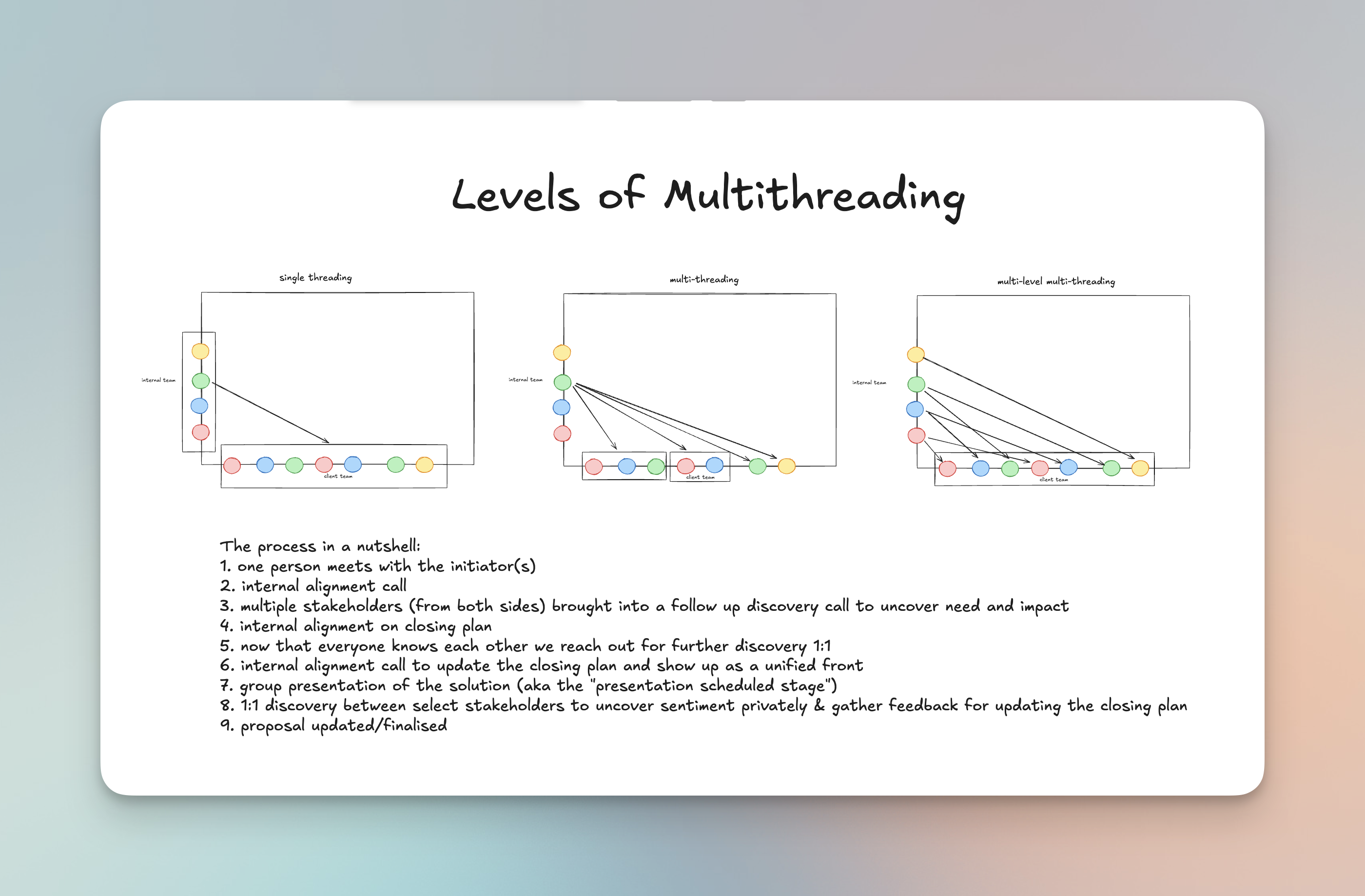
It’s not adding more people to the same conversation. It’s building parallel conversations with different stakeholders, one-on-one or in small groups, to understand how decisions really get made.
People open up in those settings. They share doubts, political friction, and constraints they would never raise in a conference call.
And having insights from across the org is the only thing that lets you predict whether a deal will actually close.
I finally understood what it meant to multi-thread strategically, and still lost the deal.
I was working a new account. A hot logo every rep on the floor would have killed for.
I started bottom-up, where it felt natural, with two users who had real pain and loved our solution.
They became coaches quickly. They were open, helpful, and pulled me into conversations with the rest of their team.
At first, I thought we were making good progress by involving more people, but it turned out the broader engineering team wasn’t convinced.
They didn’t hate us, but they had their concerns about moving away from their current provider.
Without their buy-in, this deal was going nowhere, so I changed my approach.I brought in an external technical champion from a respected company that was already using our platform in production.
Someone who spoke their native language and had lived through the same trade-offs they were debating.
That call flipped the room. The developers who were previously sceptical turned into advocates because the message didn’t come from sales. It came from a peer and expert they could trust.
That gave me bottom-up traction. But it still wasn’t enough because decisions aren’t made below the line.
People on the front line experience the day-to-day frustration, the operational pains, and they need to want the change.
But above the line is where I needed to go for the approval. Directors, VPs, and C-level leaders who cared less about features and more about whether this fit the company’s long-term direction.
And I had no connection to them.
Instead of working my way up, which would have taken weeks, I used what I learned below the line to form a point of view and asked for an introduction to the CTO through investors.
Thanks to them, we got a meeting. And that’s where the deal was shut down despite the team wanting our solution.
Turns out the CTO wanted to build their core capabilities internally.
No workaround, no political play, no discount would change the course of the deal when our solution didn't fit in with their strategic direction.
We didn’t win, but for the first time, I wasn’t guessing. I knew exactly why we lost.
That’s what strategic multithreading looks like.
Not just talking to many people, but deliberately working below and above the decision line.
⮑ Below the line, you learn where the pain lives and who will fight for change.
⮑ Above the line, you find out whether that change will ever be approved.
If you only work below the line, you can win every technical argument and still lose to an executive relationship you never built.
If you only work above the line, you’ll push a solution no one wants to use.
Complex deals need both, and it’s up to you where you start.
And as you do, keep one thing in mind: the goal isn’t to win every opportunity. It’s to stop wasting months on deals that were never yours to win in the first place.
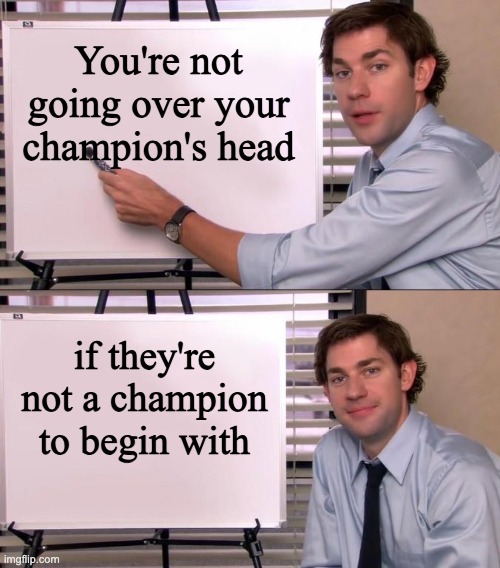
One of the most common reasons reps avoid multi-threading has nothing to do with skill.
I’ve seen it in my own deals and in teams I’ve managed. You finally have someone inside the account who likes you, responds, and seems invested.
The idea of asking for more introductions feels risky.
⮑ What if you annoy them?
⮑ What if they feel bypassed?
⮑ What if you damage the relationship that’s keeping the deal alive?
On paper, letting the champion handle things internally sounds respectful, but that type of thinking is how deals slip until buyers realise the status quo isn’t that bad after all.
I learned this watching a rep on my team work a high-profile account.
We had a strong internal advocate who had used our product at a previous company. They believed in the solution and wanted it rolled out.
Weeks passed without any progress.
The rep didn’t want to go above their contact. He believed that once the pain became obvious enough, the deal would close.
After reviewing the deal together, it became clear why it was stuck. Our contact wasn’t a champion. Not even a coach, but an advocate.
They had incentive, but no influence, and because they were new to the company, they didn’t yet understand how decisions were made.
No amount of buyer enablement would’ve helped push an initiative through.
That distinction matters.
A real champion has three things:
⮑ incentive to solve the problem,
⮑ insight into how decisions are made, and
⮑ enough influence to move people.
(Credit to Nate Nasralla)
If one of those is missing, you don’t have a champion. You have someone cheering from the sidelines.
Once we accepted that reality, we know what needed to be done to advance the deal.
The rep asked for an introduction to their manager. Not as a power move, but as a way to validate whether the problem was worth solving at a broader level.
That conversation made all the difference. The manager had context, authority, and understood the urgency. The deal closed within a month of that meeting, just in time for year-end.
Multithreading doesn’t mean disrespecting the person who brought you in.
It means being honest about the role they play.
If they truly are a champion, they’ll welcome additional conversations because it helps them win internally.
If they resist, that pushback is already telling you something important about the deal.Protecting one relationship at the expense of insights feels safe, but it’s also how you end up with surprises end of quarter.
When I told my peers I was letting my Sales Engineer run POCs without me, they thought I’d lost my mind.
From the outside, it looked irresponsible.I was the AE. I owned the number.
I was already low on pipeline, working 65-hour weeks, and staring at a gap I still had to close before year-end.
Giving up control over the most critical stage of an opportunity sounded like the fastest way to miss quota.
But I still did it because we had a plan.
At that point, most of my POCs followed the same pattern.
⮑ Tech topics.
⮑ Multiple engineers.
⮑ Me in the room, trying to stay relevant.
The conversations stayed surface-level. People nodded, asked safe questions, and saved the real concerns for later.
I walked away “involved,” but not any smarter.
So I made a call that went against sound sales judgment: I enabled my SE with a simple SOP and let him fully own the technical thread.
One-to-one calls. Small working sessions. No AE on the line.
And I wish I started this sooner.
Developers opened up. They challenged assumptions. They talked about internal constraints, workarounds, and why certain approaches would never survive production.
Conversations went deeper, faster.
Not because the questions were better, but because of the messenger.
Engineers trust engineers.
Salespeople make them cautious.
While my SE ran those conversations, we debriefed asynchronously.
After every session, we compared notes. Not feedback on feature requests, but insights gathered.
⮑ What scared them.
⮑ What excited them.
⮑ Where adoption would break if we weren’t careful.
At the same time, I used the freed-up time to multi-thread elsewhere in the account.
⮑ Business conversations.
⮑ One-on-ones with project owners and leaders above the line.
⮑ Different lens, different stakes.
During this period, I learned that discovery gets better when you stop trying to do it alone.
When you sell as a team and deliberately pair people across seller and buyer organisations based on role and seniority, you unlock a new level of insights that will help you position yourself as the preferred supplier.
Below the line, you uncover operational challenges.
Above the line, you learn whether those challenges are tied to a strategic initiative worth acting on or not.
The irony is that giving up control gave me more insights, not less.
It helped me close the pipeline gap and end the year at 136% of quota.
More importantly, it changed how I think about multithreading.
It’s not about more conversations.
It’s about the right conversations, owned by the right people, at the right level. That’s where real discovery happens.
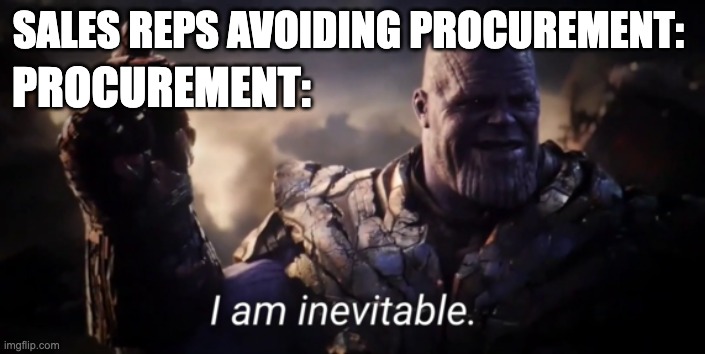
The ugliest negotiation calls I’ve been part of all had one thing in common.
Procurement showed up late, and by the time they did, it was already too late for me to influence anything.
Early on, I treated procurement like a finish line. Something you deal with once the deal is basically done.
⮑ The team liked us,
⮑ had a verbal on budget,
⮑ the POC was a success.
So now it’s just legal and commercials.
That assumption was causing my deals to slip.
When procurement gets looped in without context, they don’t see a business case. They see a vendor.
I learned this when supporting a 200k deal with a new rep on my team.
We were deliberate from the start.
⮑ We worked bottom-up with the technical teams, validated feasibility, and built real support below the line.
⮑ Before we even kicked off the POC, we asked for an introduction to the executive buyer to validate whether the problem justified the spend.
⮑ We aligned early that the deal would land somewhere between 150k and 250k.
But after that, the executive suggested looping in procurement.
That timing mattered more than I thought.
Procurement wasn’t there to renegotiate value. They were there to make sure the process ran correctly.
Due diligence, technical approvals, and commercial discussions ran in parallel with the POC instead of blocking it at the end.
By the time the RfP was out, we weren’t guessing.
⮑ The technical team wanted our solution.
⮑ We knew where the competition stood.
⮑ We understood the trade-offs the buyer cared about, and
⮑ We had already anchored the investment at an executive level.
Procurement still did their job. They pushed. They asked for concessions (some of which they got), but they couldn’t squeeze the price by much because of the relationships we’d built across the account.
I’ve seen the opposite play out too many times, first-hand.
I used to avoid procurement because I feared getting cut off from stakeholders in an attempt to keep me in the dark.
Today I know multithreading early changes that dynamic.
At times, you’ll still get restricted from engaging with certain stakeholders, but more often, procurement fills in the gaps for you that come with selling to complex organisations.
1. When you build relationships below the line, you understand preference.
2. When you engage above the line early, you anchor your solution to outcomes.
3. When procurement enters at the right moment, they operate inside that context, and you avoid missing mandatory steps that cause your deals to slip to next quarter.
Discounts and concessions don’t start with procurement getting involved. They start with a deal that’s managed in a single thread.

Recommended for you next
Knowing what not to automate is your new competitive edge in 2026
Turning Sales Navigator from a contact list into a real pipeline engine
Prospecting Playbook for 2026